
Postcards from Suzhou and Nanjing, China
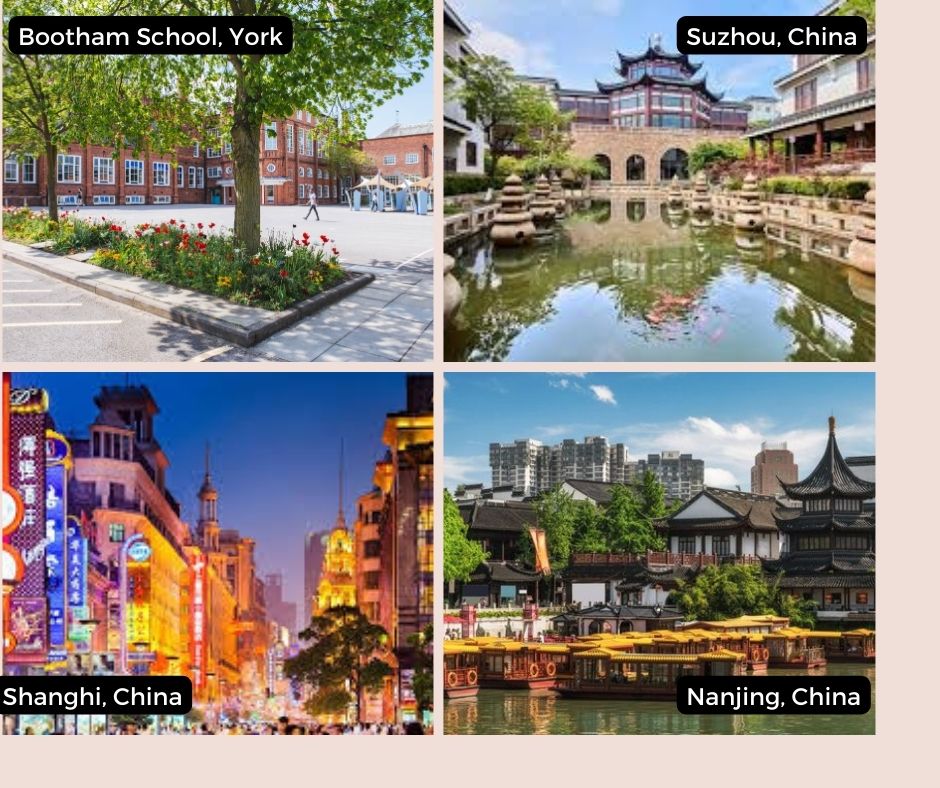
Our Head Deneal Smith has just returned from a highly successful 11,000+ miles round trip from Singapore, HK and China, where he met with prospective families, agents, current parents and Old Scholars.
As part of his trip, Deneal visited the beautiful Chinese cities of Suzhou and Nanjing (twinned with York), where he was hosted by colleagues in the Chinese education system and local dignitaries.
Deneal has written the following postcards to try and describe the beauty of the places he visited and the warmth of the hopitality he experienced.
Postcard from Suzhou
Postcard from Nanjing
Nanjing was twinned with York in 2016. The two cities share much in common: Nanjing literally means ‘southern capital’ of China – as against Beijing in the north – while for many centuries in England, York was the northern counterpoint to London. Nanjing was founded over 500 years before York’s establishment by the Roman legions in 70CE. Both are famously walled cities, sites of many significant events and home to centuries of cultural, economic and military history. But the scale of our cities is so very different – York’s 150,000 inhabitants dwarfed by over 9 million in Nanjing. The Ouse may flood York regularly, but its power is nothing compared to that of the Yangtze – the artery of south-central China that meets the ocean 300km downstream at Shanghai.
My visit in October 2024 was hosted by Nanjing Hexi Foreign Language School. As I toured round the school I saw many sights familiar to British schools: football and basketball are at the heart of the sports provision, musicians learning piano and violin (as well as more traditional Chinese instruments). The STEM room was extraordinary – a huge open space the size of six classrooms, with one area used for traditional woodwork lessons, while others are dedicated to the F1 in Schools programme, complete with a 25m racetrack and timers for the models they produce and driving simulators. Happy children of all ages welcomed me and were keen to show me their English skills – that put my negligible Mandarin to shame.
After departing the school, the first stop on our city tour was the International Friendship Park, a green oasis amid the forest of high rise buildings that accommodates Nanjing’s growing population. There I was taken to the statue of the Chinese warrior and Roman legionary playing chess – a gift to the park from York imagining a peaceful historic rivlary between east and west.
From there we visited the city’s broad walls and four chambered barbican – capable of holding enemies at bay for many centuries, with reminders of some of the bleakest moments of the civil and international wars that reach Nanjing. As when walking York’s city walls, I felt a connection with centuries of history as we passed through the gates and climbed the steep ramps to the ramparts.
And finally I was treated to a visit to the Nanjing Silk and Brocade Museum which celebrate the culture and craftsmanship behind the art of brocade. Silk threads embellished with gold, peacock feather and ostrich feather were skillfully woven to create stunning images of cranes, tigers and dragons that adorn the formalwear of the Chinese elite. To this day, machines cannot recreate the work of the most skilful weavers.
One day is insufficient to get more than a glimpse of what Nanjing has to offer the visitor. It is a truism that in England we are all too unaware of the numerous mega-cities of China that stand with or exceed London in size. Nanjing is a treasure of Chinese culture and history and a place about which more of our young people should learn.